A tummy tuck removes excess abdominal skin and reshapes the remaining tissue. However, the same surgical plan does not work for every patient.
Skin elasticity, thickness, stretch marks, previous scars, and the location of loose skin can all influence the procedure. A careful assessment helps the surgeon select an approach that suits the patient’s anatomy.
What Does Skin Quality Mean?
Skin quality is not only about how the skin looks. It also describes how the tissue stretches, moves, heals, and responds when it is repositioned.
During a tummy tuck consultation, the surgeon may examine:
- Skin elasticity
- Amount of excess skin
- Location of loose skin
- Skin thickness
- Stretch marks
- Previous surgical scars
- Tissue strength
- Signs of sun damage
- Blood supply to the area
- General healing ability
These details help the surgeon understand how much skin can be safely removed. They also influence incision placement, tension, and the expected scar.
Why Skin Elasticity Matters
Elastic skin can adjust more easily to a new abdominal shape. Skin with reduced elasticity may not contract in the same way after fat is removed or the tissue is repositioned.
This does not mean that a patient with lower elasticity cannot have surgery. It means the surgeon may need to remove more skin or choose a different tummy tuck technique.
Skin elasticity can change because of pregnancy, major weight changes, ageing, genetics, or long-term stretching. Each factor affects patients differently.
How the Surgeon Assesses the Skin
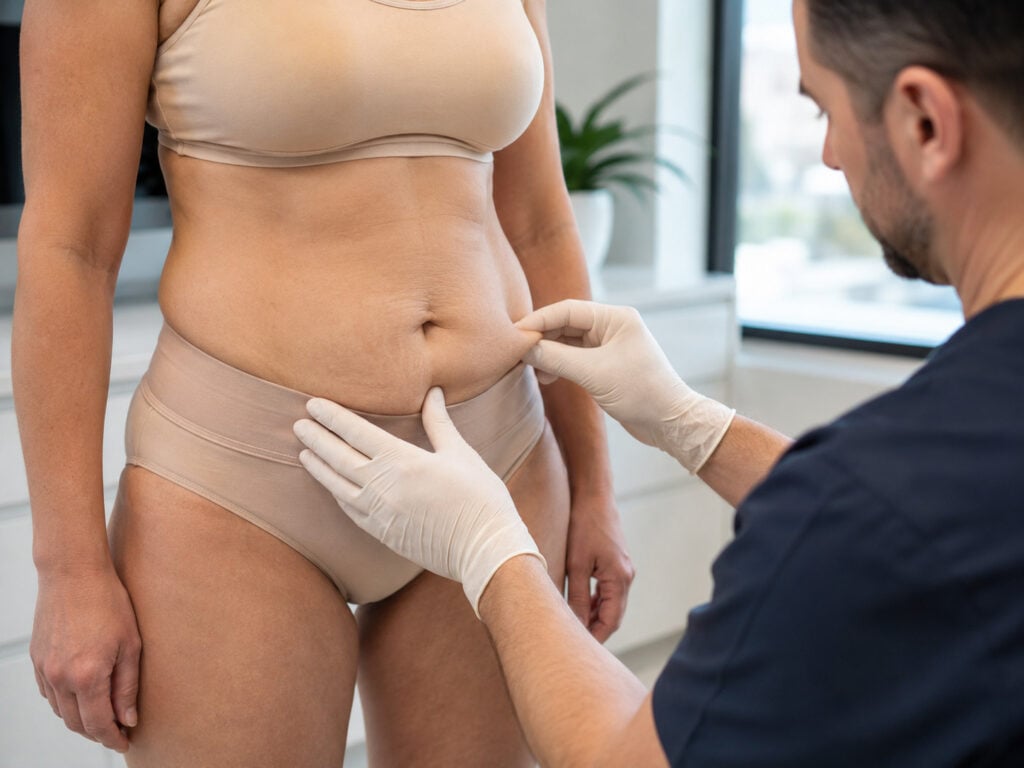
The assessment normally takes place while the patient is standing and lying down. This allows the surgeon to see how the tissue changes with body position.
The surgeon may gently move or pinch the abdominal skin to evaluate:
- How far it can be pulled
- Whether it returns to its original position
- Where the greatest looseness is located
- Whether the problem is above or below the belly button
- How the skin continues toward the sides
- Whether old scars limit movement
Photographs may also be taken for medical planning. An online consultation can provide an initial opinion, but the final surgical plan requires a physical examination.
Skin Quality Can Change the Type of Tummy Tuck
The amount and location of excess skin help determine which procedure may be suitable. The surgeon should select the least extensive operation that can safely address the patient’s needs.
| Skin Condition | Possible Surgical Approach | Main Consideration |
| Limited loose skin below the belly button | Mini tummy tuck | Does not treat significant upper abdominal skin |
| Loose skin above and below the belly button | Full tummy tuck | Usually includes a longer incision and belly button repositioning |
| Excess skin extending toward the sides | Extended tummy tuck | The incision may continue farther around the hips |
| Loose skin in horizontal and vertical directions | Fleur-de-lis tummy tuck | Allows more skin removal but creates an additional vertical scar |
| Good elasticity with mainly localized fat | Liposuction may be considered | Liposuction removes fat but not significant excess skin |
| Loose skin with muscle separation | Tummy tuck with muscle repair | Skin and abdominal wall are treated as separate problems |
Mini Tummy Tuck and Skin Quality
A mini tummy tuck is designed for a limited area below the belly button. It may suit patients who have mild lower abdominal skin excess and good skin quality above that area.
The incision is generally shorter than the one used for a full procedure. The belly button may remain in its original position.
A mini tummy tuck cannot correct loose skin across the entire abdomen. Choosing it only because the scar is shorter may leave untreated tissue above the belly button.
Full Tummy Tuck and Wider Skin Laxity
A full tummy tuck may be considered when loose skin affects both the upper and lower abdomen. During this procedure, the remaining skin is moved downward after the excess tissue is removed.
The belly button usually needs to pass through a new opening in the repositioned skin. This allows it to remain in a natural location.
The amount of removable skin influences the incision length. More extensive looseness usually requires a longer incision to avoid folds at the ends.
Patients considering this option can learn more from our complete guide to tummy tuck surgery in Albania.
When an Extended Tummy Tuck May Be Needed
Loose skin does not always stop at the front of the abdomen. After major weight loss, it may continue toward the hips and sides.
A standard incision may not treat these lateral areas completely. An extended tummy tuck allows the surgeon to remove tissue across a wider area.
The trade-off is a longer scar. This should be discussed clearly before surgery so the patient understands where the incision may finish.
Skin Thickness Influences Contouring
Abdominal skin and the fat layer beneath it vary between patients. This can change how the tissue is lifted, moved, and closed.
Thicker tissue may require a different approach to create a smooth transition. Thin skin may require careful handling to protect blood supply and reduce tension.
The surgeon also needs to consider the areas around the belly button, hips, and incision. These parts should connect smoothly with the untreated areas.

Skin Quality and Liposuction Are Closely Connected
Liposuction removes localized fat, but it does not remove a large amount of excess skin. The skin must be able to adjust after the fat volume is reduced.
When elasticity is good, the tissue may contract more effectively. If the skin is already loose, liposuction alone may make that looseness more visible.
A surgeon may combine liposuction in Albania with a tummy tuck to treat fat distribution and excess skin during the same plan. The areas and amount treated must be selected carefully to protect circulation and support safe healing.
Muscle Separation Is a Different Problem
Skin quality is only one part of abdominal assessment. The surgeon also checks the abdominal wall for muscle separation, known as rectus diastasis.
A patient can have good skin but still have muscle separation. Another person may have loose skin without needing muscle repair.
Removing skin does not automatically correct the abdominal wall. If repair is needed, it becomes a separate part of the surgical plan.
Skin Quality Influences Incision Length
A tummy tuck scar is permanent. Its length depends partly on how much skin needs to be removed and how far the looseness extends.
Trying to keep the incision too short can create folds or bunching at the sides. A longer incision may provide a smoother closure when more tissue is involved.
The surgeon usually plans the incision low on the abdomen so it can be covered by many types of underwear or swimwear. Its exact position must match the patient’s anatomy.
The Belly Button Must Match the New Skin Position
During a full tummy tuck, the abdominal skin moves while the belly button remains connected to the deeper tissue. A new opening is then created in the repositioned skin.
Skin thickness and elasticity influence the shape and position of this opening. The surgeon also considers natural shadows and surrounding tension.
This small part of the operation requires careful planning. An opening that is too large, too round, or placed under strong tension may look less natural.
Smoking Can Affect Skin Healing
Healthy blood flow is important after a tummy tuck. Smoking and nicotine can reduce circulation and increase the risk of delayed healing or tissue problems.
Patients must be honest about cigarettes, vaping, nicotine products, and certain medications. The surgical team may require nicotine to be stopped before and after surgery.
The exact instructions should come from the operating surgeon. Patients should not change prescribed medication without speaking to the medical team.
Weight Stability Supports Better Planning
Large weight changes can stretch the abdominal skin again or change the surgical result. This is why surgeons usually prefer patients to be at a stable weight before treatment.
A tummy tuck is not a weight-loss procedure. It is used to remove excess skin and reshape selected abdominal tissue.
Future pregnancy can also stretch the skin and abdominal wall. Patients planning pregnancy may be advised to delay surgery.
Can Skin Quality Be Improved Before Surgery?
Healthy habits can support the skin and the healing process, but they cannot always reverse significant tissue laxity.
The surgeon may recommend:
- Avoiding nicotine
- Maintaining a stable weight
- Protecting the skin from excessive sun exposure
- Following a balanced diet
- Managing medical conditions
- Reviewing medications and supplements
- Treating active skin infections before surgery
- Following the clinic’s preparation instructions
Creams and exercise may improve skin care or muscle strength, but they cannot remove a large fold of excess skin. Patients should be careful with products that promise surgical-level tightening.

Skin Quality Does Not Decide Everything
A good surgical plan considers the full abdomen, not only the surface of the skin.
Other important factors include:
- Fat distribution
- Muscle separation
- Previous pregnancies
- Weight stability
- Old surgical scars
- Hernias
- General health
- Circulation
- Medication
- Nicotine use
- Recovery support
- Patient expectations
Two patients with similar loose skin may receive different recommendations because these other details are not the same.
What Results Are Realistic?
A tummy tuck can remove selected excess skin and improve the abdominal contour. It cannot create perfect skin or stop future changes caused by age, pregnancy, or weight fluctuation.
Some stretch marks, natural differences between the two sides, and minor skin irregularities may remain. Scars also need time to mature.
The final appearance develops gradually as swelling reduces and the tissue settles. Patients should judge the result according to the timeline given by their surgeon.
Can a Tummy Tuck Be Combined With Other Procedures?
A tummy tuck may sometimes be combined with liposuction or breast surgery. A wider combination is often called a Mommy Makeover.
Combining procedures is not suitable for everyone. The surgeon must consider operation time, medical history, healing ability, and recovery needs.
In some cases, separate operations may be the safer option. The treatment plan should always be personalized.
Frequently Asked Questions
Does Poor Skin Elasticity Mean I Cannot Have A Tummy Tuck?
Not necessarily. Lower elasticity may change the amount of tissue removed or the type of operation recommended. The decision also depends on health, circulation, scars, and surgical risk.
Can Liposuction Tighten Loose Abdominal Skin?
Liposuction removes fat, not significant excess skin. If elasticity is limited, a tummy tuck may be needed to address the loose tissue.
Can A Tummy Tuck Remove All Stretch Marks?
No. It can remove stretch marks located on the skin that is excised. Marks outside that area usually remain.
Does Age Determine Skin Quality?
Age can affect collagen and elasticity, but it is not the only factor. Pregnancy, weight changes, genetics, sun exposure, health, and smoking history may also influence the tissue.
Does Every Tummy Tuck Include Muscle Repair?
No. Muscle repair is performed when the surgeon identifies separation or weakness that requires correction. It should not be added automatically.
Is A Shorter Scar Always Better?
Not always. The incision must be long enough to remove the planned skin without creating folds at the sides. Scar length should match the extent of correction.
Plan Your Tummy Tuck With Confidence ✨
The right tummy tuck begins with a careful examination of your skin, abdominal wall, scars, and general health. A personalized plan can help you understand which procedure fits your needs and what results are realistic.
At Medical Tourism in Albania, our team makes every stage easier for international patients:
📸 Send your photos for a free initial evaluation
🩺 Receive a personalized recommendation from an experienced surgeon
💬 Get clear information about the procedure, scar, and recovery
✈️ Receive support with appointments, accommodation, and airport transfers
📲 Stay connected with our team before and after your treatment
Ready to learn how your skin quality may affect your surgical plan?
👉 Contact Medical Tourism in Albania today and start planning your tummy tuck in Tirana with clear guidance from the first message.

 English
  Italian
  Albanian
  Spanish
  German
  Greek
Greek  French
  Dutch
Dutch  Polish