
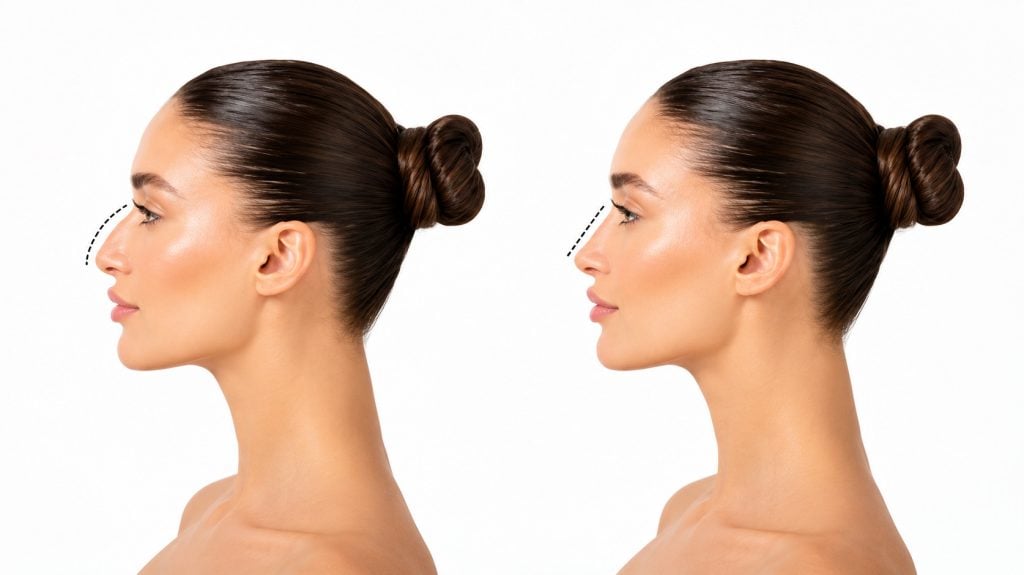
Rhinoplasty and nose fillers can both change how your nose looks, but they work in fundamentally different ways. If you are weighing rhinoplasty vs nose fillers in Albania, understanding which concerns require structural surgery and which may respond to added volume can help you ask better questions at consultation.
Rhinoplasty Vs Nose Fillers: What Is The Main Difference?
Rhinoplasty is an operation that reshapes nasal bone, cartilage, and sometimes supporting tissues. Depending on the patient’s anatomy, it may reduce a prominent bridge, refine the tip, adjust nostril shape, or form part of a plan to address breathing difficulties.
Nose fillers, sometimes called liquid or non-surgical rhinoplasty, involve injecting a substance beneath the skin to add volume in selected places. This can create the appearance of a smoother bridge or more balanced profile, but it cannot remove a hump, shrink the nose, or straighten a deviated septum.
Both approaches are described on the rhinoplasty treatment page at Medical Tourism in Albania. In the rhinoplasty vs nose fillers decision, the right starting point is your actual goal, not simply whether you prefer an operation or an injection.
What Can Surgical Rhinoplasty Change?
Surgical rhinoplasty can modify the structures that determine the nose’s shape and proportions. A qualified surgeon considers your facial features, nasal skin, cartilage strength, and airway function before deciding what corrections are feasible.
Reducing A Prominent Nasal Hump
A visible bump on the bridge may come from bone, cartilage, or both. Rhinoplasty can remove or reshape the prominence, although the surgeon must also maintain adequate structural support and a smooth profile.
This distinction is particularly relevant if you want your nose to look smaller from the side. Filler can camouflage a small hump by adding volume around it, but that changes the visual line without removing the raised structure.
Refining The Tip And Nostrils
Surgery can adjust nasal-tip projection, rotation, width, and definition by reshaping supporting cartilage. It may also address selected nostril concerns, although the exact operation depends on anatomy and should avoid compromising breathing.
If your interest is mainly in the tip, read our guide to nose tip lift candidates. It discusses how different approaches may suit different goals rather than treating every tip concern the same way.
Addressing Structural Breathing Problems
When breathing is affected, examination should identify the cause before any cosmetic plan is approved. A surgeon may need to evaluate septal deviation, nasal valve weakness, enlarged turbinates, or other conditions that filler cannot correct.
Septoplasty and functional rhinoplasty are not interchangeable with a cosmetic nose job. Our septoplasty overview explains why internal nasal obstruction requires its own medical assessment.

What Can Nose Fillers Actually Change?
Nose fillers add material rather than removing or repositioning bone and cartilage. In carefully selected patients, this can create subtle changes to surface contours without an incision or general anesthesia.
Smoothing A Small Bridge Irregularity
Filler may be placed around a minor indentation or uneven area to make the profile appear straighter. The effect comes from building up lower areas, which means the nose may become slightly fuller overall.
Someone who wants a dramatically smaller nose is therefore unlikely to achieve that goal with filler. Even when the profile looks smoother, the underlying hump remains in place.
Adding Definition To A Low Bridge
Patients with a relatively flat bridge may consider additional projection if suitable after a professional assessment. Filler can add localized volume, but excessive treatment may blur the transition between the nose and forehead or create an unnatural appearance.
An injector must consider facial proportions from the front and side. A result that looks appealing in one photograph may be less balanced from another angle.
Making Limited Tip Adjustments
In certain anatomies, carefully placed filler may subtly change the appearance of tip support or projection. However, it cannot reliably produce major tip rotation, remove a bulky tip, or correct structural weakness that affects airflow.
The nasal tip is also a particularly sensitive injection area because of its blood supply. A responsible clinician may advise against filler even when the requested change appears small.
Rhinoplasty Vs Nose Fillers: Side-By-Side Comparison
The main decision in rhinoplasty vs nose fillers is whether your goal requires removing or restructuring tissue, or whether adding limited volume could create the appearance you want. This comparison illustrates why the two treatments should not be marketed as equal alternatives.
| Feature | Surgical rhinoplasty | Nose fillers |
|---|---|---|
| Method | Reshapes bone, cartilage, or supporting tissue | Adds injectable material in selected areas |
| Can make the nose smaller? | Sometimes, depending on anatomy | No |
| Can camouflage a minor hump? | Can reshape the actual hump | May smooth its appearance by adding volume |
| Can change nostril size? | May change nostril dimensions | Cannot meaningfully reduce nostrils |
| Can improve structural breathing problems? | May be incorporated into functional surgery | No |
| Results | Long-lasting structural change, with healing variation | Temporary contour change requiring reassessment |
| Main trade-off | Surgery, recovery, scarring, and operative risks | High-risk injection area and limited achievable changes |
Neither option promises perfect symmetry or a particular celebrity nose. The plan must suit your anatomy, expectations, and tolerance for the relevant risks.
Which Treatment Fits Your Specific Nose Concern?
Patients often arrive with a photograph or one detail they would like to change. Translating that wish into a precise goal helps a clinician explain what is realistic and which procedure, if any, deserves consideration.
- “I want my nose smaller.” Surgical rhinoplasty may be relevant because filler cannot reduce tissue or overall dimensions.
- “I want to hide a small bridge bump.” Either a surgical correction or filler camouflage may be discussed, but they produce different structural results.
- “My nose looks crooked.” The cause matters; a small contour irregularity differs from a displaced framework or deviated septum.
- “I want a more defined tip.” Filler may offer limited projection, while surgery can address selected cartilage-related shape concerns.
- “I cannot breathe well through my nose.” Seek a functional nasal assessment; fillers are not treatment for airway obstruction.
If you have both appearance and breathing concerns, the rhinoplasty versus septorhinoplasty guide can help you prepare for the discussion. Choosing treatment based on a single photograph is especially unreliable when the internal nasal structures have not been examined.
Bring clear photographs taken from the front, both profiles, and the base of the nose to explain your concern. These views support discussion, but photographs cannot substitute for an examination or predict an exact result.
How Do Results And Recovery Differ Between Surgery And Fillers?
Rhinoplasty involves postoperative swelling, possible bruising, and restrictions while the nose heals. Many patients need time away from work and activities, while subtle changes in shape can continue for months as swelling resolves.
Surgery creates a structural change that is intended to be long-lasting, but aging, healing, and complications can still affect the outcome. Some patients eventually consider revision surgery, which can be more complex than an initial procedure.
With fillers, the visible change is often apparent soon after treatment, although swelling can distort the early result. Hyaluronic acid fillers gradually change or break down over time, and the duration varies with the product, area, and individual response.
Temporary does not mean completely reversible or risk-free. Even hyaluronic acid filler can produce complications, and dissolving it with hyaluronidase is not a guarantee that an injury or unwanted result can be undone.
Are Nose Fillers Safer Because They Are Non-Surgical?
Not necessarily, and this is one of the most important misunderstandings about liquid rhinoplasty. The nose has blood vessels connected to circulation around the eyes, making injection into or near a vessel a potentially serious event.
Common filler-related effects may include tenderness, swelling, bruising, asymmetry, or small lumps. Rare but severe complications include blocked blood flow, skin injury or tissue death, and vision loss, including blindness.
The US Food and Drug Administration does not approve dermal fillers for injection into the nose and advises against that use. This is a United States regulatory position, not a statement about Albanian law, but it highlights the need to investigate product authorization and safety carefully.
What Should You Ask An Injector?
Before considering nose filler, ask for the clinician’s qualifications and experience with nasal anatomy. You should also ask what product is proposed, whether its nasal use is authorized locally, and how the provider would respond immediately to suspected vascular blockage.
Warning signs after filler can include unusual severe pain, skin turning pale or dusky, and sudden visual symptoms. Any vision change or suspected vascular injury requires immediate emergency assessment; do not wait for a routine follow-up appointment.
What About The Risks Of Surgery?
Rhinoplasty has different risks, including bleeding, infection, anesthesia complications, visible scarring, persistent asymmetry, unsatisfactory appearance, and new or unresolved breathing problems. The surgeon should explain which risks apply to the proposed operation and how postoperative care is arranged.
Neither treatment should be sold as completely painless, guaranteed, or suitable for everyone. A consultation should explain why the expected benefit justifies the risks for your particular case.
Can Fillers Be Used After Previous Rhinoplasty?
Some people explore filler to conceal a small irregularity following nose surgery. However, scar tissue and altered vascular anatomy can complicate injections, making a specialist assessment especially important.
Filler is not a substitute for correcting significant structural damage or breathing problems after an earlier operation. Our revision rhinoplasty guide explains the broader challenges of assessing a nose that has already been surgically changed.
If the original operation was recent, allow your surgeon to assess healing before considering another treatment. Early swelling can make an apparent contour problem difficult to judge accurately.
How To Explore Nose Treatments In Albania Responsibly
At Medical Tourism in Albania, we help international patients compare rhinoplasty vs nose fillers and connect with medical providers. We do not perform rhinoplasty or administer fillers ourselves, and the treating clinician must determine which approach is medically appropriate.
When comparing consultations, ask who will carry out the procedure, what qualifications they hold, and where treatment takes place. For nose filler, appropriate emergency preparedness is especially important; for surgery, confirm anesthesia arrangements, recovery monitoring, and follow-up.
International patients should also ask how concerns will be handled after returning home. A brief visit to Albania should never replace the recovery time or medical monitoring recommended by the provider.
Frequently Asked Questions About Rhinoplasty Vs Nose Fillers
Can Nose Filler Make My Nose Look Smaller?
Filler cannot physically reduce nasal size because it adds volume. In selected cases, improved contours may create a more balanced appearance, but the nose may actually become fuller.
Is Nose Filler A Good Trial Before Rhinoplasty?
Filler can sometimes demonstrate how added volume changes a profile, but it cannot preview the effects of tissue removal or cartilage reshaping. Because nasal injections carry significant risks, they should not be used casually as a trial.
Will Rhinoplasty Automatically Improve My Breathing?
No, cosmetic rhinoplasty does not automatically correct nasal obstruction and can sometimes affect airflow adversely. Breathing symptoms require a specific examination and, when appropriate, a functional surgical plan.
Can A Nose Filler Result Be Dissolved?
Hyaluronic acid filler may sometimes be reduced using hyaluronidase under medical supervision. Dissolving is not always predictable and does not guarantee reversal of serious complications, particularly vision or tissue injury.
Can I Decide On Rhinoplasty Vs Nose Fillers Online?
A remote discussion can help clarify your desired change and the information a clinician needs. Final suitability requires an appropriate medical assessment, especially when breathing problems or previous nasal procedures are involved.
Find A Nose Treatment That Fits Your Goals
Still weighing rhinoplasty vs nose fillers and wondering whether your concern calls for surgical reshaping or a smaller contour adjustment? Medical Tourism in Albania can help you enquire about relevant consultations with medical providers and understand the next steps before you travel.
- Discuss your goals: Describe the shape or breathing concern you would like evaluated.
- Explore your options: Ask about rhinoplasty, filler limitations, and the type of specialist assessment needed.
- Plan responsibly: Clarify treatment arrangements, aftercare, and follow-up before making a commitment.
📧 Email: info@medicaltourisminalbania.com
📞 Phone: +355 45 627 297
🌐 Contact: Request information about your options

 English
 Italian
 Albanian
 Spanish
 German
 Greek
 French
 Dutch
 Polish