
Breast implants after weight loss can replace volume that has been lost as the body changes. However, implants alone may not correct loose skin or a lower breast position.
The right surgical plan depends on skin quality, remaining breast tissue, chest width, nipple position, and the amount of volume the patient wants to restore.
How Weight Loss Can Change The Breasts
The breasts contain glandular tissue, connective tissue, and fat. When body weight decreases, part of the fatty tissue may also reduce.
These changes can affect:
- Breast volume
- Upper breast fullness
- Skin tightness
- Breast position
- Nipple position
- Natural differences between the two sides
- The shape of the lower breast
- How the breasts fit inside clothing
The amount of change is different for every patient. It may depend on how much weight was lost, how quickly it changed, age, genetics, pregnancy history, and skin elasticity.
Not Every Patient Needs The Same Procedure
Some patients mainly lose volume while the skin and nipple position remain stable. Others have both volume loss and loose skin.
This difference is important because breast implants add volume, but they do not remove a large amount of excess skin. A breast lift reshapes and repositions the existing tissue but does not always provide the desired upper fullness.
In selected cases, the surgeon may recommend implants and a lift together.
When Breast Implants Alone May Be Suitable
Breast implants may be considered when the main concern is loss of volume. The skin should have enough strength to support the implant, and the nipple should remain in a suitable position.
Implants alone may be an option when:
- Volume loss is the main change
- Skin looseness is mild
- The nipple remains above or near the breast crease
- There is enough natural tissue to cover the implant
- The patient wants more fullness
- Breast position does not need major correction
- Weight has remained stable
The implant fills part of the empty space within the breast. It can improve fullness, projection, and balance between the two sides.
Patients can learn more about available options on our page for breast augmentation in Albania.
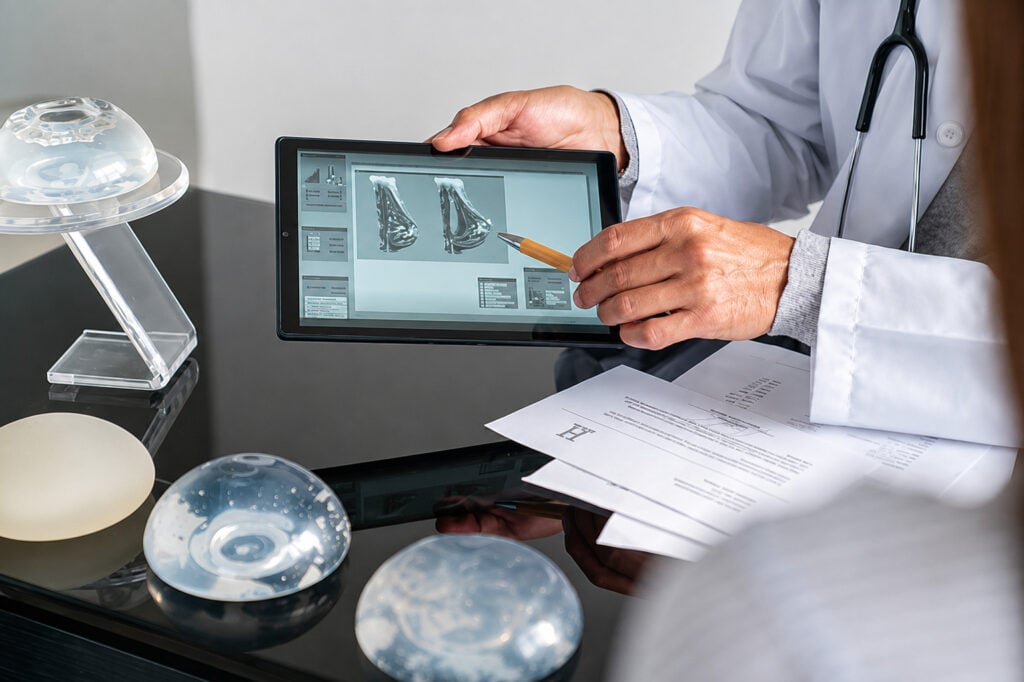
When Implants May Not Be Enough
An implant adds volume inside the breast. It does not remove stretched skin or significantly raise tissue that sits lower on the chest.
If there is moderate or extensive skin looseness, using an implant alone may create a result that still looks low. Choosing a very large implant to fill loose skin can also add unnecessary weight to tissue that is already weak.
The surgeon should not select implant size as a substitute for proper skin correction. The plan must address volume and position as separate issues.
When a Breast Lift May Be Recommended
A breast lift, also called mastopexy, removes selected excess skin and reshapes the existing breast tissue. It can also reposition the nipple and areola when needed.
A lift may be considered when:
- The skin has stretched significantly
- The breast sits lower after weight loss
- The nipple points downward
- The nipple is below the breast crease
- The areola has become stretched
- An implant alone would not correct the breast position
- The patient wants improved shape without much extra volume
Some patients may need only a lift if they still have enough natural tissue. Others may benefit from a combined procedure.
More information is available in our guide to breast lift surgery in Albania.
Breast Implants With a Lift
Combining breast implants with a lift can treat volume loss and loose skin during the same surgical plan. The implant restores selected fullness, while the lift adjusts the skin and breast position.
This approach may be suitable when weight loss has caused:
- Reduced breast volume
- Loose skin
- A lower nipple position
- Limited upper fullness
- A flatter or longer breast shape
- Differences between the two sides
The operation is more complex than implants alone. The surgeon must balance implant volume with the amount of skin removed so the closure is not placed under excessive tension.
Implants Alone Vs Lift Vs Combined Surgery
| Procedure | What It Can Address | What It Cannot Fully Address |
| Breast implants | Lost volume, fullness, projection, mild asymmetry | Significant loose skin or a low nipple position |
| Breast lift | Loose skin, breast position, nipple position, stretched areola | Major volume increase |
| Implants with lift | Volume loss and skin looseness together | Cannot stop future changes caused by weight, pregnancy, or ageing |
| Fat transfer | A modest volume change using the patient’s own fat | Large volume increase or extensive loose skin |
The best option is not automatically the largest procedure. It is the one that addresses the patient’s actual anatomy with an acceptable level of risk.
Why Weight Should Be Stable Before Surgery
Further weight loss may reduce the natural tissue around the implant. Weight gain can also stretch the skin and change the result.
Surgeons generally prefer patients to reach a stable and maintainable weight before breast surgery. The length of the stable period depends on the individual case and medical history.
Patients who have undergone bariatric surgery may also need blood tests or nutritional assessment. Protein, iron, vitamin, or other deficiencies can affect healing and should be managed before an elective operation.
Skin Quality Influences Implant Selection
After major weight loss, breast skin may be thinner or less elastic. This can affect the type and size of implant that the tissue can support.
A large implant places more weight on the skin. If the tissue is weak, this may increase the chance of future stretching, movement, or visible implant edges.
The surgeon may recommend a more moderate implant that fits the available tissue. A balanced size can provide volume while respecting the strength of the skin.

Implant Placement After Weight Loss
Breast implants may be placed above the chest muscle, below it, or in a position that uses more than one tissue layer. The best location depends on anatomy rather than a single rule.
Patients with thin tissue after weight loss may need more implant coverage. In some cases, placing part or all of the implant beneath the muscle can reduce the visibility of its edges.
Other patients may be suitable for placement above the muscle. The surgeon considers tissue thickness, skin movement, physical activity, implant type, and the need for a lift.
Existing Asymmetry Should Be Included In The Plan
Most people have some natural difference between their breasts. Weight loss may make this difference more noticeable.
The surgeon may assess differences in:
- Breast volume
- Nipple height
- Breast crease position
- Chest wall shape
- Skin looseness
- Breast width
- Remaining tissue
Different implant sizes may sometimes improve volume balance. However, no operation can guarantee perfect symmetry.
Breast Surgery May Be Part of a Wider Treatment Plan
Weight loss can affect more than one body area. Some patients consider breast surgery together with an abdominal or body contouring procedure.
A combined plan may include:
- Breast augmentation
- Breast lift
- Tummy tuck
- Liposuction
- Arm lift
- Thigh lift
- Removal of excess body skin
A breast procedure may also be included in a Mommy Makeover in Albania. Despite the name, the combination should be based on the patient’s anatomy and medical needs, not only on pregnancy history.
Combining operations is not suitable for everyone. Surgery time, blood clot risk, healing ability, and recovery support must be considered.
Scars Depend on the Procedure
Breast augmentation alone usually requires a shorter incision than a breast lift. The position may be in the breast crease, around the areola, or in another location selected by the surgeon.
A lift requires additional incisions because skin must be removed and the tissue repositioned. The scar pattern depends on how much correction is needed.
Possible patterns include:
- Around the areola
- Around the areola with a vertical line
- Around the areola with vertical and lower breast crease lines
Scars are permanent but usually change over time. The final appearance depends on genetics, skin tension, healing, aftercare, and the extent of surgery.
Risks Must Be Discussed Clearly
Every surgical procedure has risks. Breast implant surgery can involve short-term surgical complications and longer-term device-related concerns.
Possible risks include:
- Bleeding
- Infection
- Delayed healing
- Fluid collection
- Changes in breast or nipple sensation
- Visible or widened scars
- Implant movement
- Breast asymmetry
- Implant rippling
- Capsular contracture
- Implant rupture or deflation
- Need for additional surgery
- Anaesthesia-related complications
What Happens During Recovery?
Recovery depends on whether the patient has implants alone, a lift, or combined surgery. A combined operation may require more healing time because both volume and skin position have been changed.
Patients may receive guidance about:
- Surgical bra use
- Sleeping position
- Wound care
- Medication
- Showering
- Driving
- Arm movement
- Returning to work
- Exercise
- Follow-up appointments
- Implant monitoring
Patients should follow the instructions given by their own surgical team. General advice online cannot replace a personalized recovery plan.
International patients should also arrange enough time for medical reviews before flying home. Our guide to medical tourism aftercare planning explains why follow-up and travel timing should be planned before arrival.
When Can the Final Result Be Seen?
Swelling and tissue tightness can affect the early appearance. The implants may initially sit higher before settling into their planned position.
The breasts continue to change as swelling reduces, scars mature, and the surrounding tissue relaxes. This process can take several months.
Patients who have implants with a lift may need additional time before the final shape becomes clear. Healing speed varies, so results should be reviewed according to the surgeon’s timeline.
Questions to Ask During the Consultation
A good consultation should explain whether the main issue is volume loss, loose skin, lower breast position, or a combination.
Consider asking:
- Are implants alone suitable for my tissue?
- Do I need a breast lift?
- How is my skin quality affecting the plan?
- What implant width and profile fit my chest?
- Why are you recommending this implant size?
- Where will the implant be placed?
- What type of implant surface will be used?
- Where will the scars be located?
- Can existing asymmetry be improved?
- How could future weight changes affect the result?
- What are the main risks in my case?
- How will the implants be monitored?
- How long should I remain in Albania?
- What support will I receive after returning home?
The surgeon should provide clear answers without promising perfect symmetry or a permanent result.
Frequently Asked Questions
Can Breast Implants Correct Loose Skin After Weight Loss?
Implants can fill mild skin looseness when the nipple remains in a suitable position. Moderate or extensive loose skin may require a breast lift.
Is A Large Implant Better After Major Weight Loss?
Not always. A large implant can place extra weight on thin or stretched skin. The size should match the chest, tissue strength, and long-term support.
Can I Have A Breast Lift Without Implants?
Yes. A lift may be suitable when the patient has enough natural tissue and mainly wants to improve its position and shape.
Can Implants And A Lift Be Performed Together?
They can be combined in selected cases. The surgeon must consider skin quality, implant size, tension, healing, and general health.
How Long Should My Weight Be Stable?
There is no single period for every patient. The surgeon may recommend waiting until weight is stable and any nutritional problems have been treated.
Will Breast Implants Need To Be Replaced?
They are not lifetime devices. Some patients need further surgery because of rupture, capsular contracture, changes in breast tissue, or personal preference.
Restore Breast Volume With A Treatment Plan Made for You ✨
Weight loss changes every body differently. Your breast surgery should be planned around your skin, remaining tissue, chest measurements, health, and personal goals.
At Medical Tourism in Albania, we help international patients organize every stage of their treatment:
📸 Send your photos for a free initial evaluation
🩺 Receive a personalized surgical recommendation
💬 Understand whether you need implants, a lift, or both
✈️ Get help with appointments, travel, and accommodation
📲 Stay supported during recovery and after returning home
Ready to explore your breast surgery options in Tirana?
👉 Contact Medical Tourism in Albania today and receive clear guidance from the first consultation.

 English
  Italian
  Albanian
  Spanish
  German
  Greek
Greek  French
  Dutch
Dutch  Polish